 A Lockout/Tag-Out program requires installing devices on machinery during servicing or repair that prevent accidental start-up or by placing tags on machinery indicating the machine should remain off. Lockout devices or tags are also necessary anytime the removal of guards or other safety devices from machinery is necessary during servicing or repair. All industrial workplaces that use machinery in day to day operations require a Lockout/Tag-out program.
This publication outlines the requirement necessary to implement and maintain an Occupational Safety and Health Administration (OSHA) compliant Lockout/Tag-out program.
LOCKOUT DEVICES
Lockout mechanisms include key locks, chains, wedges, key blocks, adapter pins and self-locking fasteners. Lockout mechanisms prevent a machine from energizing by attaching to the energy-isolating device to stop the machine from starting.
An energy-isolating device is a mechanism that physically prevents the transmission or release of energy, including but not limited to the following.
1. A manually operated electrical circuit breaker.
2. A disconnect switch.
3. A manually operated switch where the conductors of a circuit disconnect from all ungrounded supply conductors.
4. A line valve.
5. A block or any other similar device used to block or isolate energy.
Lockout devices must meet the following requirements.
1. A key must fit only one lock and no two locks may use the same key. Never use combination locks.
2. Lockout devices must be strong enough to prevent unauthorized removal without the use of excessive force with tools such as bolt cutters or other metal cutting equipment.
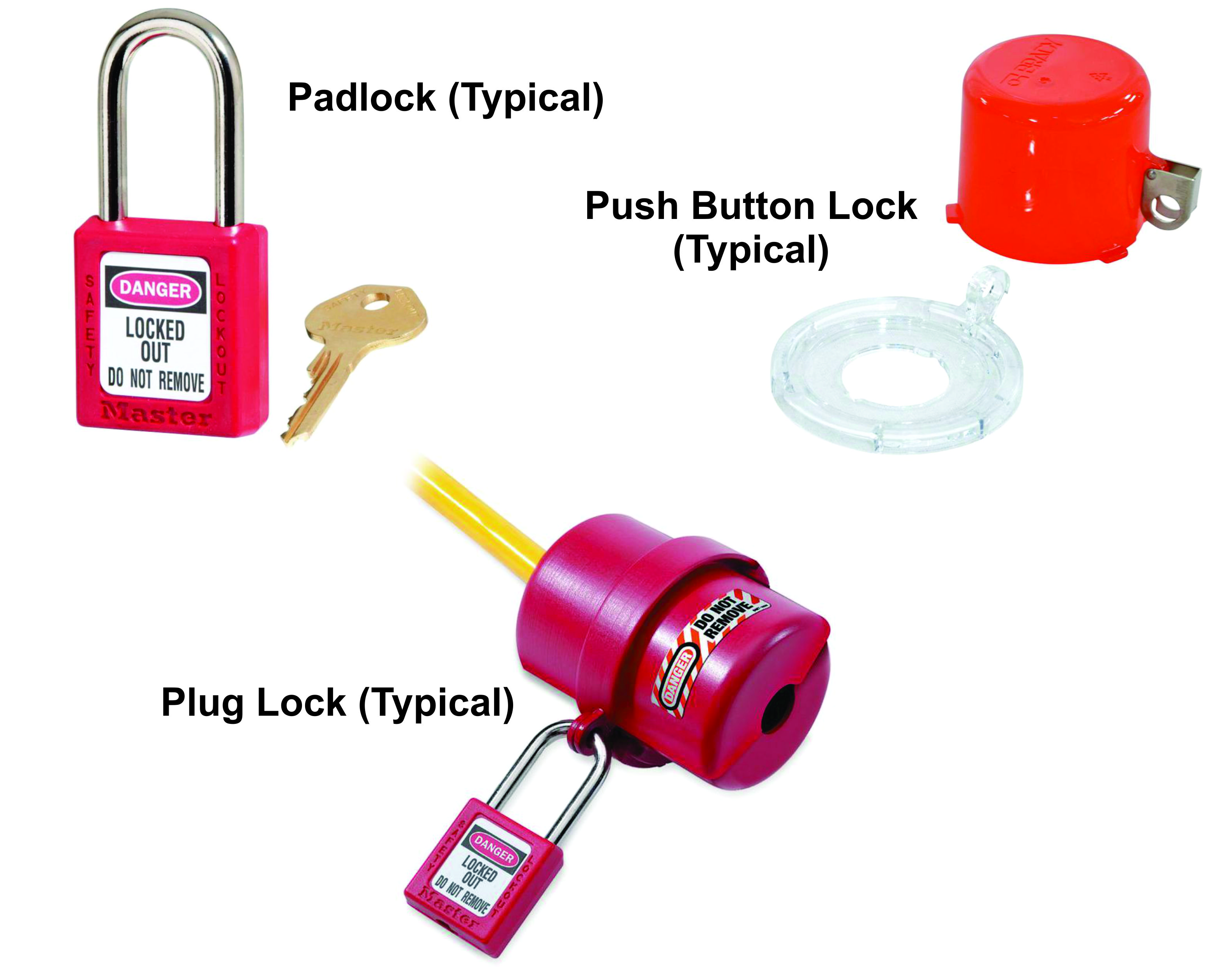
(Note how lock secures the energy-isolating device)
TAG-OUT DEVICES
A tag-out is a prominent warning sign that can securely fasten to the energy-isolating device and indicates that the machine is to remain off until removal of the tag.
Tag-out devices have the following additional requirements.
1. Standardized print and format.
2. Constructed and printed so that exposure to weather conditions or wet and damp locations will not cause deterioration or the message on the tag to become illegible.
3. Able to withstand corrosive environments.
4. Tags and attachment devices must be strong enough to prevent inadvertent or accidental removal.
5. Tag-out devices must warn against hazardous conditions if the machine is energized and include a caption similar to any of the following.
a) “Do Not Start”
b) “Do Not Open”
c) “Do Not Close”
d) “Do Not Energize”
e) “Do Not Operate”
6. All Employees who work in the area of the machinery must comprehend the purpose of the tag.
7. Employees cannot remove, bypass or ignore l a tag without authorization.
8. Securely attach tags to energy-isolating devices so that they cannot be inadvertently or accidentally detached.
9. Attachment devices have the following requirements.
a) Attachable by hand
b) Self-locking
c) Nonreleasable type with a minimum unlocking strength of no less than 50 pounds
d) Have the general design and basic characteristics of being at least equivalent to a one-piece device
e) All-environment-tolerant nylon cable tie
Tags do not have the physical restraint of a lockout device and may evoke a false sense of security. Employees need to understand the role of tags as simply a part of the overall Lockout/Tag-Out program. Unless it can be documented that a tag is just as safe as a lock for a particular machine, a lock must be used on all machinery that can be locked out.

Tag (Typical)
ADDITIONAL REQUIREMENTS
Both lockout and tag-out devices require the following features.
1. Lockout and tag-out devices have one function, to control the energy source and no other purpose.
2. Keep devices uniform within the facility and have at least one of the following identical characteristics.
a) Color
b) Shape
c) Size Lockout and tag-out devices must be capable of withstanding environmental exposures for an expected time period.
3. Lockout and tag-out devices must indicate the identity of the device. 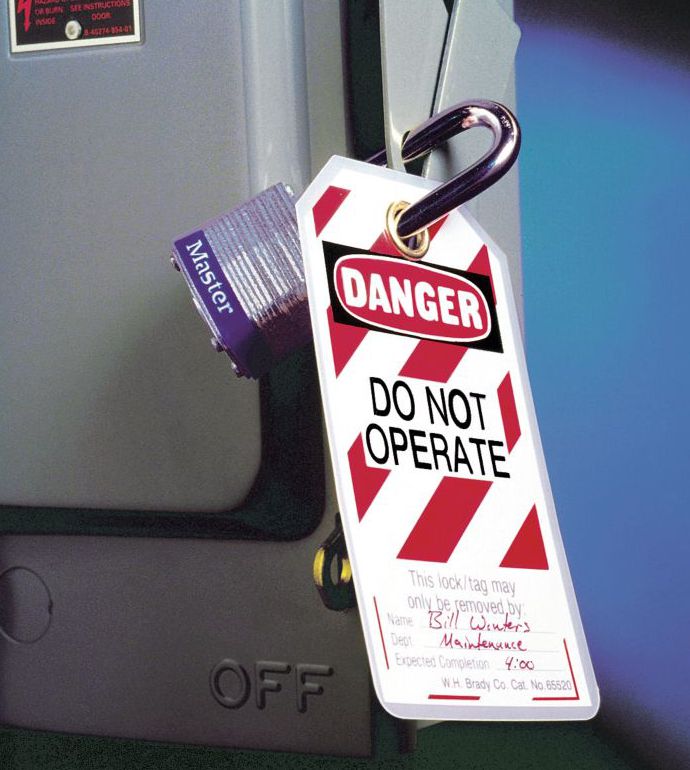
Lock-Out Device with Tags (Typical)
LOCKOUT/TAG-OUT STEPS
1. Preparation for lockout or tag-out.
a) Employees who participate in the lockout/tag-out process must understand the type and magnitude of energy that the machine utilizes, and the related hazards.
b) Notify all employees who use of the machine or work in the general area.
c) When more than one individual is required to service a machine, a group lock- out/tag-out is necessary.
2. Shut down the machine by stopping it normally.
3. Stored energy must be dissipated or restrained by re-positioning, blocking, bleeding down or any other effective method
4. Fasten the assigned lock or tag to the energy-isolating device.
5. Verify that the locked-out machine is disconnected from energy sources.
a) After ensuring that no individual is exposed, operate the controls to make sure the machine will not start.
b) Return operating controls to their “off” or “neutral” position after the test.
6. While the machine is locked out or tagged out, there must be no attempt to operate any switch, push button, valve or energy-isolating device.
7. Restoring the machine to normal operations after servicing or maintenance is completed:
a) Check the area to ensure that no individual is exposed.
b) Ensure that all tools have been removed from the machine and that all guards have been reinstalled.
c) Remove the lockout/tag-out devices and operate energy-isolating devices to restore energy to the machine.
8. When the employee who applied the lockout/tag-out device is not available to remove it.
a) The lockout/tag-out device may be removed, provided that specific procedures and training for such removal have been developed, documented and incorporated into the Lockout/Tab-Out program.
b) The removal procedures will have the following elements.
(1) Only supervisors competent in the operation of the equipment can authorize the removal of lockout/tag-out devices.
(2) Verification that the employee who applied the lockout/tag-out device is not at the facility and that reasonable efforts have been made to inform the employees that the lockout device is to be removed.
(3) The lockout device is removed with bolt cutters or other equivalent means, resulting in the destruction of the lockout device.
(4) Ensuring that employees who applied the lockout/tag-out device has knowledge of the removal action before resuming work.
9. Outside personnel or contractors who may need to lock out/tag out a machine for servicing must submit their own lockout/tag-out procedures.
10. Each year selected Employees who are not part of the lockout/tag-out team will conduct a review of the lockout/tag-out procedures for all machinery subject to the lock- out/tag-out process.
Lockout/tag-out is not necessary for minor tool changes, adjustments and other minor servicing activities that are part of normal operations and performed using alternative measures that provide effective protection
TRAINING
Employees participating in the lockout/tag-out process are trained prior to implementing any lockout/tag-out operations. Employees whose job requires use of the machine that may need servicing or maintenance will receive training at the time of hire. Retraining is provided whenever there is a change in job assignment or equipment, or whenever a modification occurs in the facility’s lockout/tag-out procedures.
Employees participating in the lockout/tag-out process are trained in the following areas.
1. Type and magnitude of energy sources found at the facility
2. Tag-out limitations.
3. Procedures for locking-out/tagging-out energy sources
4. Procedures for removing locks and or tags
5. Procedure for restoring energy
LOCKOUT/TAG-OUT PROGRAM
Facilities are required to develop written and detailed lockout/tag-out procedures for use during servicing or maintenance of machinery. The program should include the following. Lockout/tag-out procedures Training Forms to be used as part of the program
The following section outlines a Lockout/Tag-Out Program.
LOCKOUT/TAG-OUT PROGRAM
Employer name: ____________________________________
Address: __________________________________________
City, State, ZIP code: ________________________________
Phone Number: _____________________________________
Prepared by: ______________________________________
PURPOSE
To prevent the accidental or unexpected starting of machinery when servicing and maintenance is performed.
RESPONSIBILITY
____________________________ is responsible for the program and has authority to make decisions to ensure the success of the program.
____________________________ will develop written instructions covering each of the elements in this program and will update the instructions as necessary.
Only authorized Employees may lock out or tag out machinery and are identified on the Lockout/Tag-Out Procedure Form. Affected Employees are those individuals whose job functions requires use of the machinery scheduled for servicing or work in that area. Affected Employees are identified on each Lockout/Tag-Out Procedure Form. Affected Employees must be notified when a lock out/tag out will occur, as well as when the machinery is placed back in service.
____________________________ will ensure that affected Employees are identified and notified when a lock out/tag out will occur and when the machinery is placed back in service. All lockout/tag-out procedures are approved prior to implementation.
Lockout/tag-out procedures can be approved by the following persons.
Name Procedure
__________________________________ ______________________________________________ __________________________________ ______________________________________________ __________________________________ ______________________________________________ __________________________________ ______________________________________________ __________________________________ ______________________________________________ __________________________________ ______________________________________________ __________________________________ ______________________________________________
TRAINING
Lockout/tag-out training will be given to authorized Employees before they participate in the program. Affected Employees will receive lockout/tag-out training at the time of hire. Retraining will be provided whenever there is a change in job assignment or equipment, or whenever a modification occurs in lockout/tag-out procedures. will provide lockout/tag-out training and maintain a list of trained Employees, with dates of training
ANNUAL INSPECTION
Each year selected, Employees who are not part of authorized lockout/tag-out team will conduct a review of the lockout/tag-out procedures for all machinery subject to the lockout/tag-out process.
Name Procedure __________________________________ ______________________________________________ __________________________________ ______________________________________________ __________________________________ ______________________________________________ __________________________________ ______________________________________________ __________________________________ ______________________________________________ __________________________________ ______________________________________________ __________________________________ ______________________________________________
LOCKOUT/TAG-OUT PROCEDURE FORM
Instructions: Complete this information sheet for each piece of equipment scheduled for servicing.
Equipment: ___________________________________
Department: ___________________________________
Supervisor: ____________________________________
Date: _________________________________________
Energy sources and locations: ____________________________________________________________________________________ ____________________________________________________________________________________ ____________________________________________________________________________________
Type of lock or energy-control device: _________________________________________________
Authorized Employees: _____________________________________________________________
Procedure developed by: ____________________________________________________________
Lockout/tag-out procedure ____________________________________________________________________________________ ____________________________________________________________________________________ ____________________________________________________________________________________ ____________________________________________________________________________________ ____________________________________________________________________________________
 John Sadlouskos